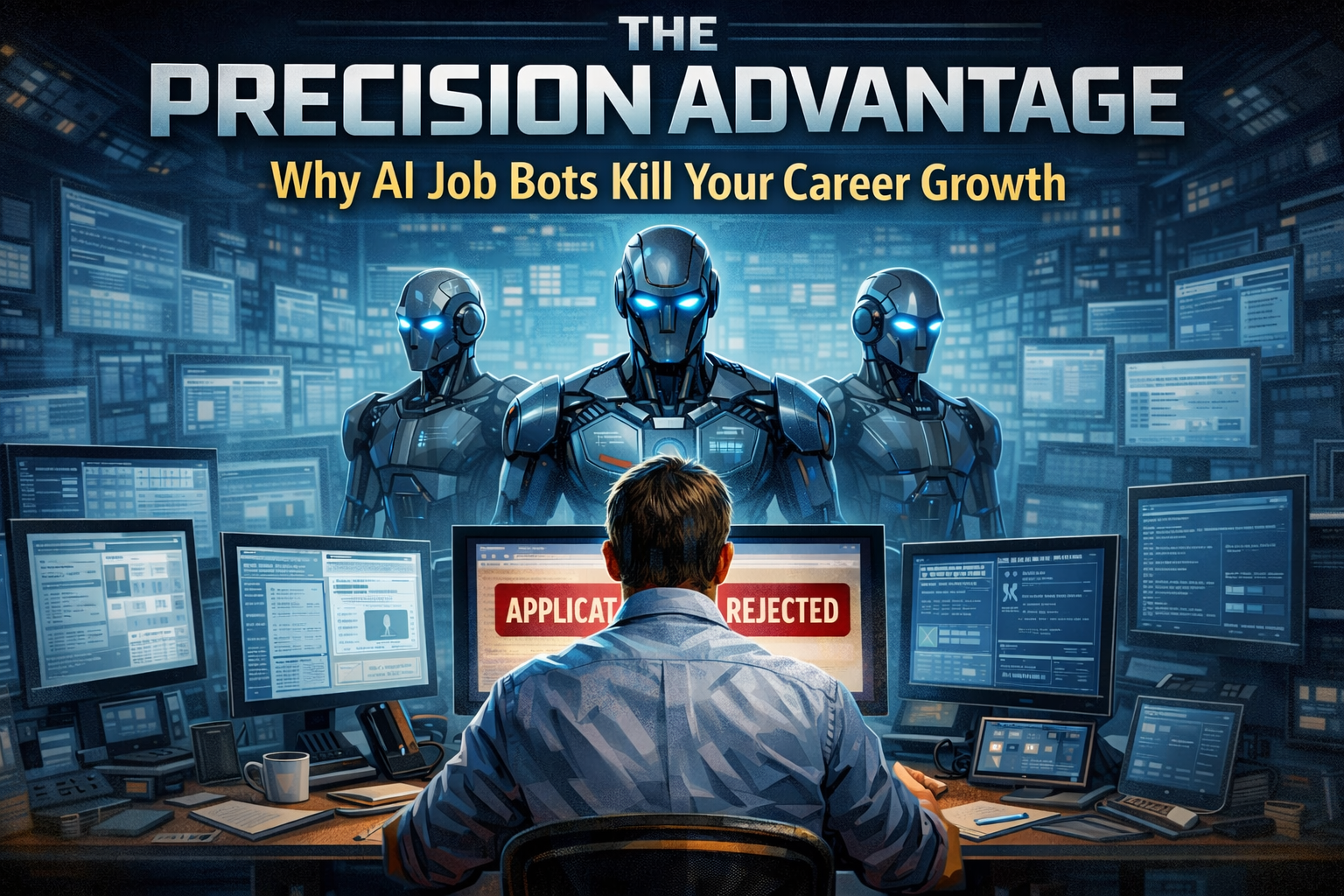
The Precision Advantage: Why AI Job Bots Kill Your Career Growth
5 min read • Sun Apr 05 2026
If you are a professional navigating the 2026 job market, you are likely already familiar with the intense frustration of modern job boards. Platforms like LinkedIn, Indeed, and Glassdoor offer access to thousands of open roles, but the process of actually getting your foot in the door feels more like playing the lottery than building a career.
The common advice is to use technology. People turn to AI-powered browser extensions and autofill bots to mass-apply to hundreds of jobs a week. It seems like a shortcut, a way to hack the system. But we hear the same story constantly at Biding Services: these tools have not led to more interviews.
In fact, the reliance on automation is often the exact reason your career growth has stalled. Here is the uncomfortable truth the software developers won’t tell you: standard automation is killing your job search. Your applications are either failing basic filters or looking like spam to recruiters. To win, you don’t need more speed. You need more precision.
(H2) The Hidden Failures of Automation in Application Forms
Automated job application bots work on a simple premise: they scrape data from your uploaded resume and inject it into form fields. This sounds great in theory, but modern application systems like Greenhouse, Lever, and especially the deeply complex Workday portals are intentionally designed to prevent this kind of low-signal applying.
These portals are not standard HTML. They use intricate structures that generic automation cannot handle reliably. Here is what actually happens when you use an autofill bot:
- Data Scrambling: The bot often maps your data incorrectly. Your past job titles might end up in the education field, or your bullet points are joined into a single unreadable paragraph.
- Missing Field Error: Many forms ask unique questions (such as “Are you willing to travel?” or “What is your base salary expectation?”) that are not on your generic resume. The bot often skips these or answers them randomly, triggering automatic disqualification.
- The “Workday Trap”: Workday systems often force you to manually confirm that parsed information matches your resume. Autofill software simply hits “Save and Continue,” submitting a profile full of errors that recruiters cannot read.
A generic submission from a bot looks exactly like what it is: spam. Recruiters are now using tools specifically to identify and discard applications made with detectable automation.
(H2) Why AI Bots Cannot Master the Jobright or Otta Ecosystems
We must also look beyond the standard forms. The most innovative job search platforms of 2026, such as Jobright and Otta, are built with high-signal filtering. They prioritize quality and matching rather than raw volume.
- Otta: This platform uses AI to match candidates, but it relies on your explicit input about preferences and company culture fit. An autofill bot cannot answer the nuanced culture questions that Otta uses to prioritize your profile.
- Jobright: This site uses AI to help you identify high-probability matches. A bot cannot read the job description and decide if you are truly the “verified match” the system is looking for. It just applies, bypassing the exact value Jobright offers.
By mass-applying to these platforms with generic tools, you are shadow-banning yourself. You may technically be “applying,” but your profile is never shown to human decision-makers because you haven’t navigated their high-signal filters with any precision.
(H2) The Human Quality Control (HQC) Difference
This is where the standard model of applying breaks down and where Biding Services offers a critical advantage. We don’t use simple generic automation. We are a human-first Reverse Recruiting service. When you hire us, our expert team manages your entire job submission cycle with the precision required to win.
We understand the difference between Greenhouse and Workday. Our team ensures your profile is submitted correctly by following several key Human Quality Control (HQC) protocols:
- Contextual Mapping: We read the specific job description and map your actual experience, not just generic resume text. Only a human can understand that your “Operational Lead” title at a startup is perfect for a “Senior Operations Manager” role at a large corporation.
- Accuracy over Speed: We navigate the dreaded Workday portals manually. We verify that every single date, education detail, and job description is entered correctly and formatted neatly. Our goal is to ensure you are seen, not just counted.
- Platform Expertise: We treat LinkedIn applications differently than Otta applications. We tailor our approach based on the specific culture and filtering mechanisms of the platform we are managing on your behalf.
(H2) Reclaim Your Time: Stop Being a Data Entry Clerk
If you are a professional earning a salary of $80,000, $150,000, or more, your time has a specific dollar value. Spending 15 hours a week performing repetitive data entry on complex forms is a profound waste of your primary resource. You are not being lazy by outsourcing this. You are being smart.
While our team at Biding Services manages the tedious, technical grind of submitting 20 or 30 high-quality applications across Indeed, LinkedIn, and various corporate portals, you can focus on the activities that actually secure job offers:
- Interview Mastery: Deeply researching the target company’s market position and practicing strategic storytelling.
- Targeted Networking: Connecting meaningfully with hiring managers on LinkedIn, now that you aren’t exhausted from applying.
- Professional Skill Upgrading: Completing certifications or projects that elevate your marketability.